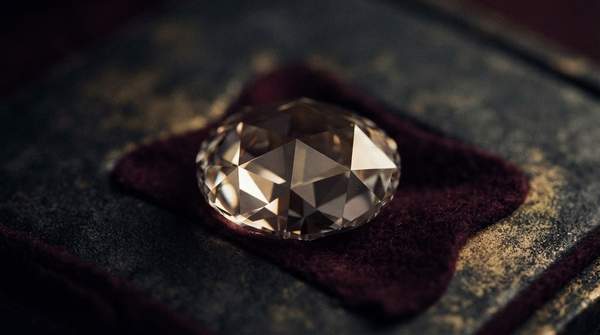
Three specialized cuts dominate the world of high jewelry beyond the familiar brilliant and step styles, and each answers a different question. The rose cut answers with a soft shimmer; the briolette answers with all-over sparkle; the cabochon answers with pure color and optical phenomena. The structural difference among them is what drives those effects: a faceted dome with a flat base, a fully faceted teardrop, or a smooth, unfaceted dome.
Introduction to Specialized Gemstone Cuts
Not every gemstone is served by maximizing brilliance. Some stones carry their beauty in color and texture; others reveal internal optical effects that facets would obscure. High jewelry designers therefore reach for older or more specialized cutting styles when the goal is atmosphere, movement, or phenomenon rather than raw light return. The rose cut and the briolette belong to the same family of faceted domes and teardrops, while the cabochon abandons facets altogether. Understanding how each structure handles light is the key to evaluating why a piece was cut the way it was.
The Rose Cut: Vintage Elegance and Soft Luster
The rose cut is built on a flat base topped by a domed crown, similar in silhouette to a cabochon but with the dome cut into facets. Jewelry historian Christina Paluszek-McClure, writing for Kryzia Kreations, describes the arrangement as anywhere from 6 to 12 to 18 to 24 triangular facets arranged like the spiral of petals on a blooming rose. That count matters: the relatively few, relatively large facets are the reason a rose-cut stone gives a soft, sensual shimmer rather than the intense sparkle of modern faceted cuts.
The shallow, flat-bottomed design has a practical consequence as well. Rose cut stones appear larger than brilliant cut counterparts of equivalent weight, because the broad crown spreads the stone's face without the deep pavilion a brilliant cut requires. Paluszek-McClure notes that rose cuts are enjoying a resurgence, which aligns with their vintage aesthetic: a subdued glow that suits antique-inspired settings where intense scintillation would feel out of place.
The Briolette Cut: All-Around Sparkle and Movement
The briolette takes the triangular-facet logic of the rose cut and applies it to the entire stone. As described by the gemology writers at Gem Rock Auctions, a briolette is a pear-shaped or oval stone covered across its whole surface in extended triangular facets, most commonly triangular and hexagonal. There is no table and no pavilion in the conventional sense—the cut is fully faceted from every viewpoint.
That completeness is the source of its effect: light interacts with the stone from all angles, producing what the Gem Rock Auctions guide calls "lots of sparkle and lots of color from the stone." Because nothing is hidden against a setting, a briolette is inherently a suspended cut. It is associated with the rose-cut family, but its functional identity is movement—a drop earring or pendant that turns freely keeps its surface perpetually catching light, a property celebrated in the large emerald, ruby, and sapphire drop earrings worn by high-profile public figures.