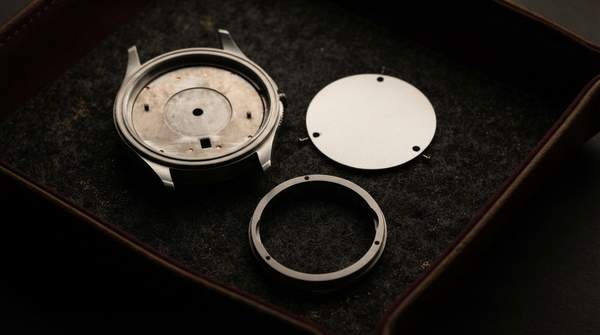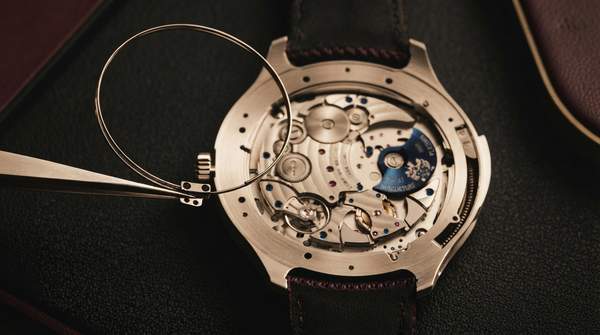
A minute repeater's chime is not a single sound but the engineered outcome of three distinct mechanical stages: sound generation by hammers striking gongs, pacing by a regulator, and amplification through the case. Small steel hammers strike gongs—steel wires wrapped around the movement inside the case, as Patek Philippe, a maker of chiming watches, describes the mechanism—to signify the hours, quarters and minutes on demand. Understanding which components control which acoustic property, and how watchmakers manipulate them, is the key to understanding why these mechanisms demand hundreds of components and extreme precision.
Stage 1: Sound Generation – Hammers and Gongs
Sound production relies on two gongs: a low-pitched gong and a high-pitched gong, tuned to produce a harmonious musical interval, according to the horological encyclopedia Horopedia. The larger hammer strikes the low-pitched gong while the smaller hammer strikes the high-pitched gong, as Cortina Watch's explainer of the complication puts it. In contemporary constructions the gongs take the form of metal wires coiled around the outer perimeter of the movement—an architecture that maximizes the length of the resonant wire and, consequently, the duration and intensity of the sound produced.
Geometry can go further than the conventional two-gong pair. Cortina Watch cites the Parmigiani Fleurier Carillon Tourbillon 30th Anniversary, which features four gongs in an unusual "serpentine" shape to enhance resonance and produce four distinct notes: a low note for the hours, a high note for the minutes, and two additional tones for the quarters. The hammers themselves are a tuning variable as well: Horopedia notes they must strike the gong with precise and regular force so every stroke is identical in intensity and tone, and their adjustment in position and pressure is one of the delicate operations of assembly and fine-tuning.
Stage 2: Sound Pacing – The Regulator's Cadence
Without a regulating organ, the energy stored in the striking barrel would be released in a fraction of a second, making the chime incomprehensible and irregular, per Horopedia. The governor—also called a regulator—regulates the speed of the striking pattern, in other words the pace of the individual chimes. The repeater's works run off their own smaller auxiliary spring, and the governor sits at the end of that train, introducing resistance: less resistance accelerates the striking speed, while more resistance slows the chimes, as the watch publication SJX Watches explains in an article on repeater governors.
The pacing matters acoustically, not just mechanically. An even pace, spacing out the intervals between individual strikes, produces superior acoustics, Cortina Watch notes. If the interval is too tight, the gongs may still be vibrating from previous strikes and sounds can compete and cancel each other out, reducing overall acoustic quality. Pace too slow, and the tune falls out of tempo while the increased resistance can affect the striking mechanism's power reserve. Achieving the ideal speed, SJX Watches observes, is based solely on human intuition and judgement—there is no purely mechanical shortcut to the sweet spot.