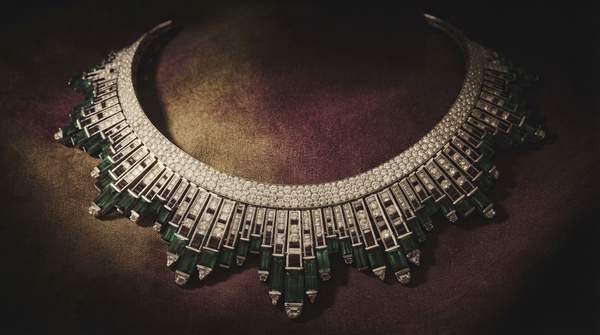
Art Deco high jewelry is defined by three things you can see at a glance: strict geometric symmetry, bold color contrast, and platinum-set construction delicate enough to be almost invisible. Emerging in the 1920s and 1930s, the style abandoned the flowing ornament of the Victorian and Edwardian eras in favor of clean lines, chevrons, sunbursts, and stepped architectural patterns. Its influence persists in contemporary luxury design, where the same vocabulary—angular silhouettes, black-and-white stone pairings, and multi-functional structures—continues to resurface. This article breaks down those pillars and maps each one to its modern reinterpretation, giving you a working framework for spotting Art Deco DNA in a current piece.
Introduction: The Enduring Allure of Art Deco High Jewelry
Art Deco jewelry remains the reference point against which modern luxury design is measured, and the reasons are structural rather than sentimental. Writing for Ivy & Rose, Mona Porter identifies the style's core as "clean lines, geometric shapes, and bold symmetry," with rectangles, triangles, circles, and trapezoids arranged for balance and visual harmony. Leon Diamond's design commentary frames the era as one of "geometry and glamour," where symmetrical patterns inspired by skyscrapers and machinery produced angular shapes like chevrons and sunbursts. What distinguishes Art Deco from neighboring styles is this discipline: every motif is deliberate, every contrast engineered. That legibility is precisely why contemporary designers keep returning to it.
The Roaring Twenties: Cultural and Technological Catalysts
The style did not appear from nowhere. As Yanina-Co's Russell Silber explains, Art Deco was "born out of a desire to break free from the ornate and elaborate styles of the Victorian and Edwardian eras," embracing modernity and "a celebration of the machine age," with inspiration drawn from Cubism, Bauhaus lines, and the motifs of ancient civilizations. Christie's collecting guide adds the harder historical edge: war had ravaged European cultural centers, women had filled industrial roles vacated by men at the front, and the style's emphasis on structure "respond[ed] to a widespread desire for order in the wake of chaos."
The movement's public debut is generally placed at the 1925 Exposition Internationale des Arts Décoratifs et Industriels Modernes in Paris—an exhibition largely dedicated to the jewelry arts, as Antique Jewelry University notes, emphasizing the association of art and modern industry. From the Vault's Ella Brock records the era's social texture: flappers wore long pearl strands, tassel earrings, and jewelry with strong contrasts that symbolized "freedom, jazz, and a break away from pre-war rigidity," while influences arrived from Africa, South America, and Asia, including ancient Egyptian motifs and tribal patterns.