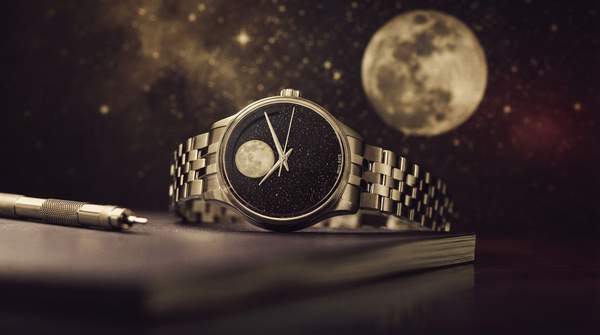
A moon phase complication shows the current state of the moon—new, first quarter, full, last quarter—on the dial, and its accuracy is determined almost entirely by the number of teeth on one driving wheel. A standard 59-tooth mechanism drifts by a full day roughly every two and a half years; a 135-tooth "astronomical" moon extends that to over 122 years; and rare perpetual designs, such as Andreas Strehler's "Lune Exacte," push the deviation to one day every 14,000 years or more. Understanding these tiers—and whether the display is "bosom" or "radial"—is the key to reading any moon phase watch's complexity and value.
Introduction to Moon Phase Complications
A moon phase indication is a complication that visualizes the main states of Earth's satellite—first quarter, full moon, last quarter, and new moon, as the Fondation de la Haute Horlogerie's encyclopedia defines it. Its mechanical difficulty lies in the awkward interval between two full moons: the synodic month lasts 29 days, 12 hours, 44 minutes and a few seconds, a figure no simple gear train divides evenly. Watchmakers therefore approximate it, and the quality of that approximation is the whole story of the complication.
The idea is far older than the wristwatch. Historical tracking places the earliest known moon phase mechanism in the Ancient Greek Antikythera Mechanism, built to predict astronomical events and eclipses, whose complexity reportedly went unmatched for some 2,000 years. Moon phase indicators later appeared on astronomical clocks of the 14th and 15th centuries, including the Prague Astronomical Clock of 1410, which still tracks lunar phases today. By the 20th century, the FHH notes, the complication had become "essentially a romantic feature"—yet one that drives a substantial share of haute horlogerie's engineering effort.
Comparing Moon Phase Complication Accuracy
The single component that separates a modest moon phase from an astronomical one is the driving wheel. The comparison below traces how tooth count translates directly into correction intervals—an owner correcting a display roughly every three years versus one that will outlive several generations.
| Mechanism Type | Driving Gear | Accuracy (Error of 1 day per...) | Typical Correction Interval |
|---|---|---|---|
| Standard moon phase | 59-tooth wheel, advanced one notch every 24 hours | Approximately 2 years, 7 months (about 2.7 years) | Roughly every three years |
| Astronomical moon phase | 135-tooth wheel with a more elaborate gear train | 122 years and 46 days (about 122.6 years) | A lifetime or more |
| Perpetual / ultra-precise | Continuously driven multi-wheel designs | Over 14,000 years (up to 2.045 million years for the record-setter) | Effectively never within a human lifetime |
The standard system works like this: the wheel's 59 teeth correspond to two lunar cycles of 29.5 days each, and a fingerpiece pushes it forward one notch every 24 hours, per the FHH. Because 29.5 days is a rounding of the true 29-day, 12-hour, 44-minute synodic month, the display accumulates a one-day difference in about two years and seven months—requiring periodic manual adjustment, normally after around three years. Writing for Quill & Pad, Joshua Munchow frames the stakes: that "accuracy" equates to a timekeeping error of one minute and 34.6 seconds per day, something no one would accept from a chronometer.