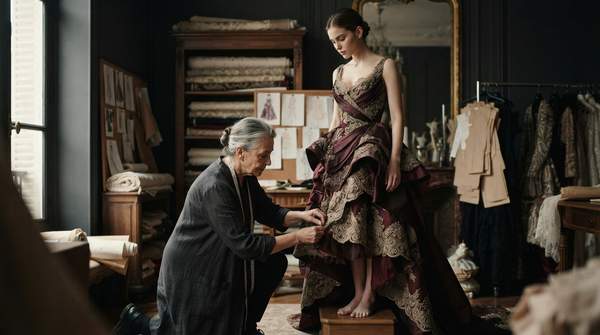
Can you simply walk into a Parisian couture house, write a cheque, and leave with a gown? Not remotely—and the reason is historical. The haute couture client relationship has been inverted over the past century and a half: from a service in which the client dictated and the dressmaker executed, to a model in which the designer supplies the vision, and finally to today's hyper-personalized, invitation-shaped bespoke experience. The pivot point, as fashion historians consistently record, was the Englishman Charles Frederick Worth, who in the mid-nineteenth century reversed the power dynamic so completely that a woman entering his atelier, as one account puts it, "was no longer simply commissioning a dress. She was buying into an idea of herself."
From Client-Led Craft to Designer's Vision: The Worth Revolution
Before Worth, the arrangement was almost artisanal in its humility. The dressmaker's role, as A&E Magazine recounts, "had largely been to respond to the wishes of the client." A wealthy woman arrived with a conception—perhaps a fabric, an engraving, an instruction—and the atelier executed it. The craft was considerable; the authorship was not. The client was, in effect, the designer, and the dressmaker a skilled interpreter.
Worth (1825–1895) shattered that contract. Instead of merely fulfilling client requests, he introduced his own design collections, cultivating a distinct aesthetic and affixing his name to his creations. This practice, as A&E Magazine highlights, established "the designer as author"—a radical reversal where the designer provided both the garment and its underlying vision.
The Style Historian catalogues the machinery of this new relationship: Worth was the first to stage salon shows twice a year, gathering clients at his atelier to view a collection; the first to stitch his name into clothing, inventing the brand label; the first to showcase designs on live models; and, fittingly, the first to whom the very term "fashion designer" is credited.
Claire Wilcox, writing in the Cambridge Global History of Fashion, confirms the structural shift: the House of Worth, like many that followed, operated on a business model in which "unique seasonal designs would be created by the head of the house, or auteur, and made to order for clients by in-house ateliers."
The 20th Century: Solidifying the Designer as Author
What began as one Englishman's audacity became the industry's grammar. Wilcox traces couture's rise as "unstoppable" after Worth's success, as grand couturiers—both men and women—followed him to Paris, drawn by its network of skilled artisans and material luxury. Each house was named after its founder and cultivated its own distinctive sensibility, but all inherited the same essential relationship: the auteur proposed, the client assented. The client's agency did not vanish, but it migrated. No longer directing the design, she now selected among visions—choosing a house whose aesthetic matched her self-conception, then collaborating within it.
This is the quiet genius of the Worth settlement, and why it endured through the twentieth century. The designer's authority was never absolute tyranny; it was authority exercised through desirability. The seasonal collection, the label, the live model—all of Worth's innovations, as The Style Historian notes, "set the foundation for the fashion industry as we know it today." Sotheby's guide to couture makes the same point from the collector's side: the evolution of modern fashion, and even the term "fashion designer" itself, is "intrinsically bound with haute couture." The twentieth century did not so much change the model as professionalize and mythologize it.
Evolution of the Haute Couture Client Relationship
The three eras below condense the whole transformation—read down the middle column to see the power flow reverse, and down the right column to see how the practical experience of being a client changed with it.
| Era | Dominant Client-Designer Dynamic | Key Innovations in Client Experience |
|---|---|---|
| Pre-Worth era (early 19th century) | Clients dictated designs; the dressmaker's role was to follow their instructions and execute their wishes. | A direct commission: the client brought the conception, and the service delivered the garment she had in mind. |
| Worth revolution (mid-19th century) | The designer became an author, presenting his own creative vision rather than awaiting instructions—a radical shift from client-led to designer-led fashion. | Seasonal salon shows held twice a year, live models presenting the designs, and the brand label stitched into garments: the house now dictated fashion rather than following client wishes. |
| Modern era (21st century) | A hyper-personalized, exclusive bespoke experience conducted within the designer's creative framework—clients collaborate and adjust, but do not originate. | Access gated by track record, recommendations, and brand relationships; a multi-stage process of sketches, prototypes, and fittings over months, often beginning from a runway look and customized to the individual. |
The pattern is legible at a glance: the client moved from director of craft, to patron of art, to member of an exclusive service club—each stage trading a measure of creative control for a deeper measure of belonging.
The Exclusive World of Modern Haute Couture Clients
And what a club it is. The Pink Lookbook likens access to the fabled Hermès Birkin waiting game, then raises the stakes: haute couture, the site explains, is "not easy to be accepted in this exclusive club of about 4,000 clients. It requires a track record, recommendations and a relationship with the brand." Once accepted, the experience is custom-tailored in the fullest sense—brands often maintain separate floors exclusively for couture clients, and for certain clients the designer and their team may fly to the customer to take measurements or adjust garments. The house comes to you; that, too, is part of the inversion.
Who populates this circle? Vogue's Kristen Bateman, reporting amid the fall 2024 couture shows in Paris, describes a market that is booming, with one stylist-adviser, Nolan Meader, noting appointments so scarce that brands could not see him until January. The buyers, in the experience of the vintage dealer she quotes, are "strictly private clients—women that have very successful businesses"—not celebrities, whose teams are reportedly more frugal. Prices frame the exclusivity: simple pieces start around $50,000, with extravagant ones edging toward $800,000, and vintage Chanel couture gowns sometimes near $100,000. (These figures are illustrative of the market Vogue describes, not a price list.)
The Bespoke Journey: From Runway to Personal Masterpiece
What does the modern commission actually feel like? It typically begins not with a blank page but with a runway look—the designer's vision, already authored. The client's role is collaborative adaptation: selecting a design, then personalizing it through a multi-stage process of sketches, prototypes, and fittings that can unfold over months, ensuring a perfect fit and unique customization. The Pink Lookbook offers a vivid example in the collector Mouna Ayoub, whose Schiaparelli couture gown worn at Cannes in 2024 was adapted from the runway version—a higher "screen" element was shortened for her. The vision was Schiaparelli's; the final proportions were Ayoub's.
The relationship culminates in a detail of almost heraldic intimacy: many houses add a customized label bearing the client's name to the finished garment. The client's name is literally stitched into the designer's creation—two authorships, one garment, with the house's clearly primary.
The Enduring Value of a Couture Relationship
Why does this improbable arrangement persist—and flourish—in an age of fast fashion? Because the product was never merely the dress. From Worth onward, the client has been buying membership in a vision: first an idea of herself, as A&E frames it, and now an entire service architecture—private floors, traveling fittings, named labels, garments that exist nowhere else. The Pink Lookbook's account of separate couture floors and house visits, and Vogue's portrait of booked-out appointments and strictly private clientele, describe the same phenomenon from two angles: scarcity of access is not an obstacle to the relationship but its very substance.
The modern client thus holds a paradoxical position Worth's clients could not have imagined. She has less creative authority than her 19th-century predecessor, who walked in with her own design—yet she receives a depth of personal service, exclusivity, and intimacy that predecessor never dreamed of. The trade was agency for belonging, and by every account of the current market, clients consider it an excellent bargain.
Navigating the Modern Couture Relationship
For the reader who wonders how one actually enters this world, the evidence yields a clear decision: prospective clients must cultivate a relationship with a couture house and be prepared for a highly personalized, multi-stage process that adapts designer visions to individual needs. There is no walk-in purchase; there is a courtship—track record, recommendations, and brand relationship first, then collaboration within the designer's aesthetic rather than direction of it.
How would you know the courtship is succeeding? The measurable indicators are concrete: successful engagement is signaled by invitations to exclusive shows, direct consultations with client advisors, and the commencement of the multi-fitting garment creation process. When the house starts flying to you, and your name appears inside the garment, the relationship Worth invented—and his successors perfected—has arrived at its modern form.
Sources
- Cambridge
- The History of Haute Couture and Its Enduring Influence on Fashion - A&E Magazine
- <br/>The history of haute couture — The Style Historianᵀᴹ
- The Complete Guide to Haute Couture — Sothebys.com
- Haute Couture Explained - What Is It and Who Buys It? - The Pink Lookbook
- Made to Measure: Inside the World of Haute Couture Clients — Vogue