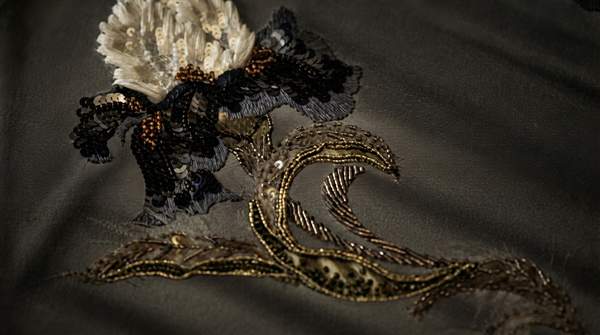
Haute couture embroidery is not merely elaborate stitching. According to a practitioner trained at the École Lesage—one of the schools attached to the specialized embroidery houses serving the great fashion houses—it is the hand embellishment of couture garments with beads, sequins, precious threads, feathers and other applied materials, executed almost always by dedicated embroidery houses working on behalf of the fashion houses. What sets it apart from hobbyist needlework is threefold: its techniques, its workshop organization, and its economics, which count everything in hours of skilled handwork.
What Defines Haute Couture Embroidery?
The definitional line is drawn less by the stitches themselves than by the entire mode of production. The Lesage-trained practitioner behind the account this article draws on puts it plainly: haute couture embroidery "differs from hobby embroidery in its techniques, the Lunéville hook among them, in its workshop organisation and in its economics: everything is counted in hours of skilled handwork." The Lunéville hook—a hooked needle that carries thread through fabric from behind—is emblematic of this professional repertoire.
There is also a lineage dimension. The same account notes that haute couture embroidery is "one of the sources of French art embroidery," with some French embroidery artists—including the author—trained in its schools and techniques. In other words, the couture atelier functions as both workshop and academy, a place where a distinct professional tradition is transmitted rather than merely practiced. (One detail governs the whole craft, we are told: a couture dress is never embroidered as a dress. It is embroidered flat, in pieces, before it exists as a garment—and that single constraint shapes everything from sampling to assembly.)
The Role of Specialized Embroidery Houses
The organizational structure is a deliberate division of labor. As the account frames it, the fashion houses sign the collections, while specialized embroidery houses carry out the embroidery. A couture client may never learn the name of the atelier whose hands covered a bodice in beads; the label on the garment belongs to the designer whose sketch originated the work.
This arrangement explains much about the finished garment. The embroidery house is not a subcontractor executing instructions mechanically; it is the custodian of techniques—the Lunéville hook, needle embroidery, the laying of gold thread—that the fashion house itself does not practice. It is where the sample is made, where the hours are counted, and where the flat, piecemeal embellishment that will later become a dress is actually sewn. The fashion house supplies the creative brief and, ultimately, the signature; the embroidery house supplies the trained hands. One may reasonably ask which partner contributes more to the shimmer of a couture collection—but the system is built so that both are indispensable.