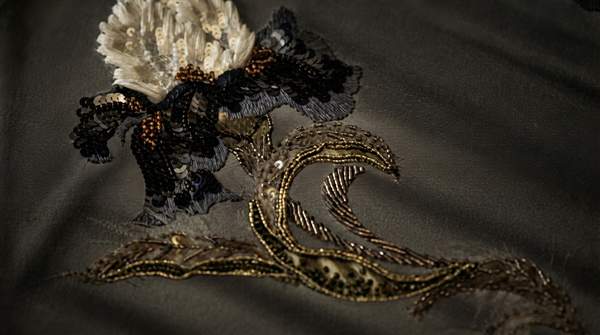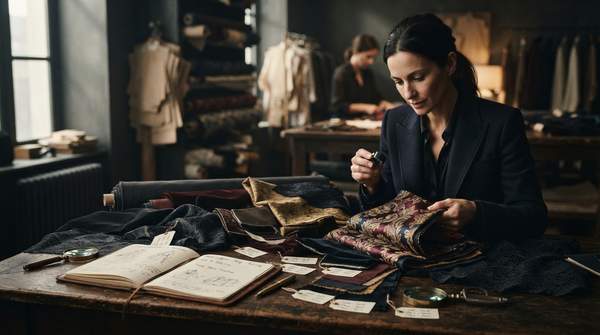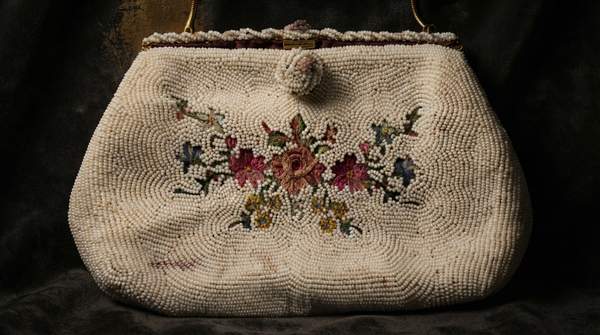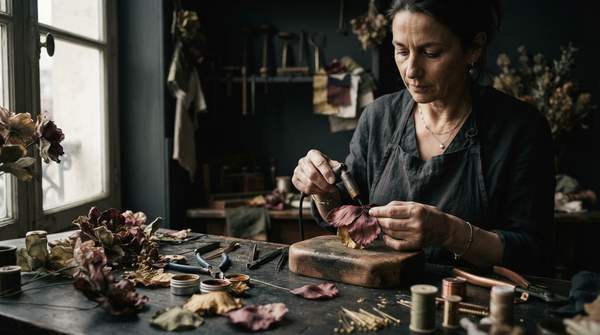
What does it take to turn flat silk into a camellia that seems to breathe? The answer lies with the parurier floral, the French flower maker whose craft sits at the intersection of botany and couture. According to le19M, the Paris center for Chanel's specialty ateliers, the process is "a meticulous series of technical steps": fabrics are dyed and processed, petals are die-cut, softened on a damp blotter, sculpted with a wax-soaked hot metal ball, and finally assembled by hand around a brass stem. The Institut pour les Savoir-Faire Français adds that each flower is entirely handmade, carrying the maker's individual imprint—the character of uniqueness proper to a natural flower. This article reconstructs that workflow into four distinct stages and explains why each material is chosen.
The Parurier Floral: Architects of Couture Blooms
The title itself deserves unpacking. A parurier floral is not simply a florist with a needle; the French term designates a specialist in artificial flowers, a discipline with its own tools, vocabulary, and lineage. Le19M describes the maker working through a fixed technical sequence—dyeing, cutting, softening, shaping, finishing, assembling—each step demanding its own instruments and its own judgment. The Institut pour les Savoir-Faire Français, which classifies parurerie florale among France's rare savoir-faire, emphasizes that the craft requires a very specific range of tools whose manufacture ceased around 1930, meaning today's practitioners must rescue dies from old workshops or commission tools made to measure.
Why does haute couture still insist on this slow, hand-bound process when a machine could stamp a petal in a second? Because, as the Institut puts it, each creation bears the imprint of the person who made it. The flower's value lies precisely in the trace of the hand—a quality no industrial process replicates. Le19M records that only two major Maisons d'art specialized in this discipline remain active in France: Légeron, owned by Lemarié since 2019, and Lemarié itself. The craft is, quite literally, carried by a handful of hands.
The Four Stages of Couture Flower Making
The narrative descriptions from le19M and the Institut pour les Savoir-Faire Français can be deconstructed into a sequential model. Each stage has its own actions, tools, and purpose, and the order matters: a petal cannot be shaped before it is cut, and cannot hold its shape unless the fabric was prepared first.
| Stage | Action | Tools / Techniques | Purpose / Effect |
|---|---|---|---|
| 1. Preparation | Fabrics are dyed and processed; the material is stiffened | Apprêtage (stiffening the fabric) | Gives the fabric body so it can hold a shape |
| 2. Cutting | Petals and leaves are cut from the prepared fabric | Die cutters (emporte-pièces) in many shapes | Uniform, precise petal shapes |
| 3. Shaping | Cut pieces are softened on a damp blotter, then worked into form | Hot metal ball soaked in wax; gaufroirs | Three-dimensional volume and realistic contour |
| 4. Assembly & Finishing | Petals arranged one by one around the central stamen on a brass stem; glued; leaves arranged; stem coated | Special pliers; techniques boulé retouché, frisotté, plissé; tissue paper or gutta percha | A complete, lifelike flower |
The reasoning path is straightforward: preparation gives the raw material its working properties, cutting defines the components, shaping gives them life, and assembly unites them. The glue then dries for several hours before the final touches, le19M notes—an unhurried tempo that is itself part of the craft. Read the table top to bottom and you have the entire biography of a couture bloom, from bolt of cloth to finished ornament.