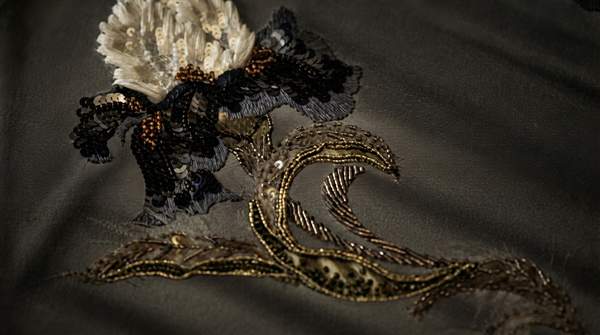
Point de Beauvais is a hook-worked chain stitch: the embroiderer drives a fine hook through fabric drum-tight on a loom, picks up sewing thread from underneath, and draws up a chain on the right side of the cloth. Despite its name, it was not invented in Beauvais at all (more on that irony shortly), and it survives today as a valued haute couture skill, taught alongside the celebrated Lunéville hook technique at institutions such as École Lesage. Understanding it means tracing a technique that crossed continents before it crossed the Rue de Rivoli.
The Ancient Roots of Hook Embroidery
The story begins, according to legend, with a silkworm and an empress. As the textile historian Rebecca Devaney recounts, Chinese tradition credits Empress Xi Ling Shi with discovering the silkworm around 2,700 BC, with the techniques of silk manufacture developed by her ladies-in-waiting. Successive dynasties guarded these secrets fiercely while exporting luxurious silk fabrics and exquisite embroideries along the Silk Road from roughly 1000 BC, until knowledge of silk production gradually spread across Asia, Africa and Europe.
Crucially for our technique, Chinese embroiderers had developed a method of embroidering with a frame and a hook. This innovation travelled across India and the Ottoman Empire, mastered by artisans along the way. Devaney places its French arrival in the late 18th century, via the port of Marseille, from which it eventually reached the Royal Court—where Madame de Pompadour, official mistress of Louis XV, embraced it so devotedly that one version took her name: the Point de Pompadour.
What of Beauvais itself? The city in the Oise was a major drapery centre from the Middle Ages, and Colbert's royal tapestry manufactory, planted there in 1664, made it famous across Europe by the 18th century. Yet, as the embroidery atelier of Valérie notes with some amusement, the city's history says nothing of the stitch bearing its name. Specialists today point instead to an Indian origin, carried to Europe by one of the many "Compagnies des Indes." Charles-Germain de Saint-Aubin, draughtsman and embroiderer to Louis XV, recorded in his 1770 treatise L'art du brodeur that the hook arrived in France around 1760.
Deconstructing the Point de Beauvais Technique
How, then, does one actually make this stitch? The descriptions scattered across specialist sources assemble into a coherent four-part method, which the following framework isolates component by component.
| Element | What it involves | Why it matters |
|---|---|---|
| Tools: hook and loom | A crochet-like hook (the same instrument as Lunéville embroidery) worked over fabric stretched on an embroidery loom | A tambour hoop will not do; the fabric must be perfectly taut |
| Material: sewing thread | Fil à coudre replaces cotton mouliné | Mouliné is discarded as too brittle for this hook work |
| Process: two hands | Left hand beneath the loom holds the thread; right hand above pierces the fabric with the hook, catching the thread | The hands work in continuous dialogue, one feeding, one drawing |
| Result: chain stitch | The hook pulls the thread to the surface, forming a chain stitch on the right side of the fabric | The visible chain, worked on the face of the cloth, is the signature of the technique |
The essential insight is that Point de Beauvais is not needle embroidery at all. The hook replaces the needle entirely; the left hand beneath the frame becomes as important as the right above it, supplying thread at precisely the moment the hook descends to catch it. Practitioners report that the gesture demands real practice at first—then becomes, in Valérie's words, addictive, bringing concentration and calm. (A rare confession, surely, from anyone who has wrestled with a slipped chain.)