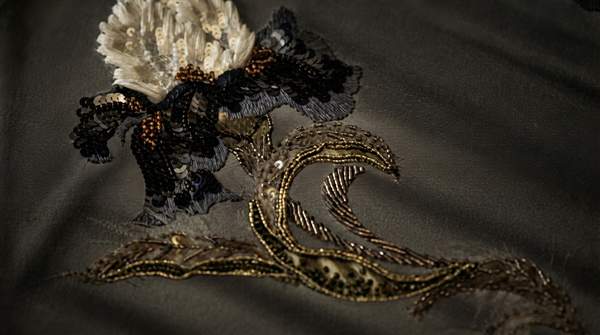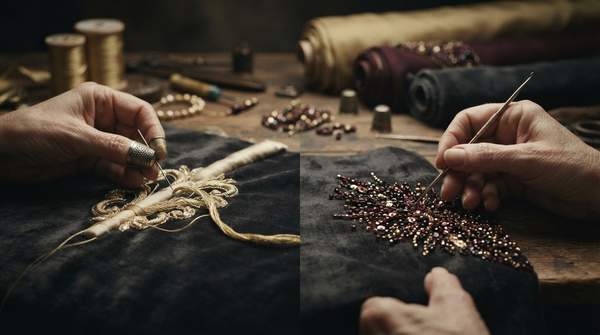
Look closely at a couture gown and ask a deceptively simple question: is that shimmer coming from metal laid upon the fabric, or from beads stitched through it? The answer separates the two great embroidery traditions of high fashion. Goldwork couches metal thread onto a surface; tambour (in its couture form, Lunéville) pulls a hooked chain stitch through it. Different origins, different tools, different mechanics—and, crucially, different aesthetics.
Introduction: Distinguishing Goldwork and Tambour Embroidery in Haute Couture
Goldwork and tambour are frequently confused by the casual observer, because both produce ornate, light-catching embellishment on luxury garments. But they are not variations of one another; they are two distinct traditions that evolved centuries and continents apart before French couture adopted them both. The distinction rests on four tests: where the technique was born, what the embroiderer holds in her hands, what the thread is made of, and—most tellingly—whether the thread passes through the fabric or merely lies upon it.
Historical Trajectories: From Ancient Roots to French Couture
The two techniques took opposite roads to Paris. Goldwork emerged in the Eastern Mediterranean around the 4th century CE—fragments recovered from Coptic textiles in Egypt's Akhmim region show gold foil wrapped around silk cores, a precursor to modern passing thread. By the 10th century, Byzantine workshops in Constantinople had refined the technique for imperial and religious garments, embedding gold threads into linen and silk grounds.
Tambour's journey was later and faster. As the textile historian Rebecca Devaney recounts, Chinese silk embroiderers developed a technique using a frame and a hook, which traveled across India and the Ottoman Empire, mastered by artisans along the way. In the late 18th century it arrived in France via the port of Marseilles and reached the Royal Court, where Madame Pompadour embraced it so enthusiastically it became known as the Point de Pompadour. Tambour entered the Lunéville ateliers in 1810, and in 1865 Louis Ferry Bonnechaux, the mayor of Lunéville, invented a technique that would exponentially increase its speed and, in Devaney's phrase, literally turn the craft upside-down.
Goldwork: Materials, Tools, and Couching Mechanics
Goldwork's defining constraint is its material: metal thread cannot be repeatedly pulled through fabric without fraying or breaking. The technique therefore inverts ordinary embroidery. The metal thread is laid on top of the ground fabric and secured with smaller stitches—a process called couching. The metal thread itself never pierces the cloth; only the fine securing threads do.
This is why goldwork reads as it does. Because the metal sits entirely on the surface, it catches light continuously across the laid thread, producing the luminous, dimensional planes familiar from Byzantine religious vestments and imperial garments. The historical technique, as described in accounts of goldwork practice, embedded gold threads into linen and silk grounds using split-stitch couching—a method that simultaneously anchors the metal and builds texture.
Tambour Embroidery: The Hook, Chain Stitch, and Speed
Tambour works the other way around. The embroiderer stretches fabric on a frame and works with a hook—held above the frame like a pen, while the other hand stays beneath it, presenting the thread. Each loop locks the last, so the stitches build into a continuous chain formed on the underside of the fabric. Crucially, the thread never has to be pulled all the way through.
That single mechanical fact explains tambour's couture career. Because the same gesture can pick up a bead or sequin from below and lock it into the chain, it attaches embellishments much faster than a needle can. As the embroiderer Franck Delorme explains, that speed is precisely why the haute couture ateliers of Paris still embroider their gowns this way. Lunéville embroidery is the French couture branch of the same technique—the two terms name the same movement, drawn from two different histories.
Application in Haute Couture: Luminous Surfaces vs. Beaded Embellishments
In practice, the two techniques answer different design questions. Goldwork is chosen when the garment calls for metallic dimensionality—surfaces that read as solid light, with the historical gravitas of ecclesiastical and imperial precedent. Tambour, particularly in its Lunéville form, is chosen when the design demands intricate beading at a scale of thousands of beads that no ordinary needle could deliver in a workable timeframe.
One might frame it as a trade between permanence and pace: goldwork's couching is deliberate, thread by precious thread, while tambour's chain is a continuous, rhythmic production. Neither is superior; they occupy different positions in a couture atelier's vocabulary, and a single gown may deploy both.
Comparative Table: Goldwork vs. Tambour Embroidery
The table below juxtaposes the two techniques across five parallel attributes—origin, tools, materials, stitch mechanics, and couture application—to isolate their defining differences.
| Technique Feature | Goldwork | Tambour Embroidery |
|---|---|---|
| Historical Origin | Eastern Mediterranean, c. 4th century CE; refined in 10th-century Byzantine Constantinople for imperial and religious garments | Chinese silk embroidery; traveled through India and the Ottoman Empire; arrived in France via Marseilles in the late 18th century, adopted by the Royal Court |
| Primary Tools | Needle and frame; the metal thread is worked onto the surface | Hook held like a pen above a frame, with the second hand beneath presenting thread |
| Typical Materials | Metal threads (gold foil wrapped around silk cores) couched onto linen and silk grounds | Silk or cotton thread; especially efficient for attaching beads and sequins |
| Core Stitch Mechanic | Couching: metal thread laid on top of the fabric and secured with smaller stitches; the metal thread is not pulled through the fabric | Continuous chain stitch formed on the underside, each loop locking the last; the thread never has to be pulled all the way through |
| Application in Couture | Luminous, dimensional metallic surfaces with historical resonance | Rapid bead and sequin embellishment—the Lunéville specialty of Parisian ateliers |
Read side by side, the rows make the confusion impossible to sustain: goldwork is a surface technique of laid metal; tambour is a through-fabric technique of interlocked chain.
Choosing Between Goldwork and Tambour for Haute Couture
Designers select goldwork for creating luminous, dimensional, and historically rich surfaces, while tambour embroidery, particularly Lunéville, is chosen for its speed and efficiency in applying beads and sequins. The measurable indicator is visible on any finished garment: heavy metallic dimensionality signals goldwork, while intricate beading signals tambour. The next time a gown stops you mid-runway, run that single test—metal laid upon the cloth, or beads locked beneath it—and the technique will announce itself.