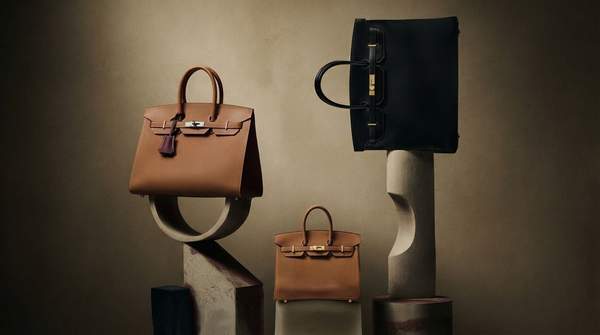
For daily wear, Togo and Epsom are the forgiving choices; for a rigid, formal silhouette, Epsom or Box Calf; for a glossy finish that matures into a vintage patina, Box Calf alone. That, in essence, is the decision an Hermès buyer faces, and it is a genuine trade-off rather than a hierarchy: the leathers that shrug off scratches are not the ones that develop the most character. Christie's, whose collecting guide frames the question around durability and silhouette, puts it plainly—Togo, Clémence and Epsom suit everyday use, while Epsom and Box Calf create structure and Clémence and Swift slouch. The specialist reseller Privé Porter, whose leather-by-leather specifications anchor this comparison, adds the texture and aging detail that turns taste into an informed choice.
Understanding Key Hermès Leathers: Togo, Epsom, Box Calf, and Chèvre Mysore
Togo, introduced in 1997, is calfskin with a fine pebbled grain, fine veining and a semi-matte finish; the pebbled pattern feels smooth to the touch, according to PurseBop's guide. It is the default Birkin leather, and Privé Porter rates its scratch resistance high, its weight medium, and its structure medium with a slight slouch—relaxed without collapsing. Christie's calls the combination of sophistication with durability what makes Togo so sought-after for the Birkin.
Epsom is a different animal: a pressed calfskin with a fine, even, cross-hatched grain created through embossing, brought in to succeed Courchevel in 2004. It is lightweight, rigid, and highly scratch-resistant—Privé Porter's table pairs it with the Sellier Kelly and Mini Kelly II, silhouettes where crisp lines are the whole point. Box Calf, by contrast, is glazed, smooth and glossy calfskin, rated low on scratch resistance because, as Privé Porter notes, its scratches blend into a patina; it is very structured and associated with vintage Kellys. Chèvre Mysore, a goatskin with a fine grain and natural luster, offers high scratch resistance, light weight and shape retention—Privé Porter recommends it for Mini Kellys and small Birkins.
Hermès Leather Decision Matrix
The matrix below normalizes the descriptive language from Privé Porter's specifications with Christie's silhouette guidance and the care guidance from Fabrinique and London dealer JULL, so the trade-offs line up side by side. Read it as a map of compromises: durability and structure sit at opposite corners from patina and softness.
| Leather | Texture | Scratch resistance | Structure | Aging / water behavior | Best for |
|---|---|---|---|---|---|
| Togo | Pebbled grain, fine veining, semi-matte; smooth to the touch | High | Medium, slight slouch; medium weight | Light rain beads; prolonged exposure darkens and spots | Everyday Birkin |
| Epsom | Fine, even pressed (embossed) crosshatch | High | Rigid; lightweight | Tolerates barely-damp spot treatment | Sellier Kelly, Mini Kelly II |
| Box Calf | Smooth, glossy, glazed | Low—shows every scratch and water mark | Very structured; medium weight | Scratches blend into a unique patina; highly water-susceptible | Vintage Kellys, formal occasions |
| Chèvre Mysore | Fine grain, natural luster, soft sheen | High | Holds shape; lightweight | Water resistance less explicitly documented; tolerates barely-damp spot treatment per general guidance | Mini Kellys, small Birkins |
What the table reveals is that no leather wins on every axis. Togo and Epsom dominate the durability column; Epsom and Box Calf dominate structure; Box Calf alone owns the patina column, and it pays for that with the worst scores on scratch and water resistance. Chèvre Mysore is the quiet compromise—high scratch resistance and shape retention at light weight—though its water behavior is less explicitly documented than Togo's or Box Calf's.