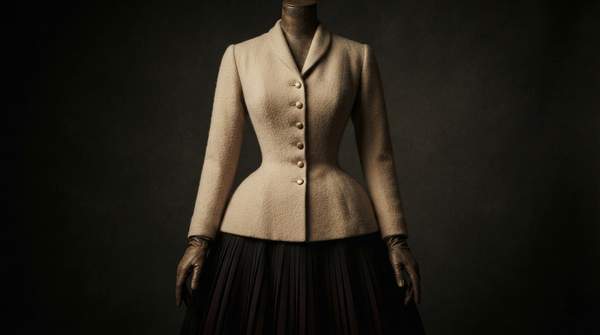
Christian Dior's "New Look," unveiled on February 12, 1947, dramatically reshaped post-World War II fashion by introducing a silhouette characterized by opulent femininity and intricate structural design. This revolutionary collection, initially known as "Corolle" and "En 8," offered a stark contrast to the utilitarian styles prevalent during wartime austerity. It quickly became a symbol of French haute couture's rebirth and set a new course for fashion, emphasizing a return to glamour and sophistication through its distinctive architectural elements and meticulous construction.
The Post-War Genesis of Dior's 'New Look'
Christian Dior's inaugural collection emerged during a period of significant societal change following World War II, a time marked by an "Arctic winter" in Paris. After years of military and civilian uniforms, coupled with sartorial restrictions and shortages, Dior offered more than just a new aesthetic; he presented a "new outlook," according to The Metropolitan Museum of Art. This curvy silhouette achieved unparalleled success, both symbolically and commercially, representing the rebirth of French couture after the German occupation and quickly gaining international acclaim across Europe and America.
The establishment of the House of Dior in 1946, backed by textile manufacturer Marcel Boussac, was part of a broader effort to reestablish Paris's couture industry as a component of France's economic and social recovery. Dior's design expertise, combined with his marketing acumen, led to a wildly successful fashion enterprise. From 1947 to 1957, the House of Dior dictated fashion across Europe and the United States, as noted by the Avenir Museum of Design and Merchandising, demonstrating the profound impact of his initial statement.
Defining the Iconic Silhouette: An Overview
The "New Look" marked a dramatic shift in women's fashion, moving away from the utilitarian styles of the war years towards a celebration of decorative femininity. Vogue's editor at the time, Edna Woolman Chase, observed in her memoir that Dior's clothes, while wearable, gave women "the feeling of being charming costumed," imbued with a romantic flavor. The silhouette was celebrated for its luxurious fabrics and elegant lines, evoking a sense of glamour and sophistication that had been absent during wartime.
Characterized by rounded shoulders, cinched waists, and full skirts, the "New Look" emphasized an hourglass figure, a deliberate departure from the angular, restricted forms of wartime fashion. This aesthetic embraced a vision of ultra-femininity and opulence, creating a distinct figure-eight silhouette. The Avenir Museum of Design and Merchandising notes that this shape was often complemented by large picture hats, which further accentuated the wide curve at the top of the figure, rounding out the overall dramatic and sometimes unexpected shapes achieved through Dior's unique combination of draping and tailoring.
The Anatomy of the New Look Silhouette
The "New Look" was not merely an aesthetic concept but a triumph of structural engineering in fashion, meticulously crafted to achieve its distinctive form. Each component played a crucial role in shaping the body into the desired hourglass figure, celebrating opulence and femininity through precise design and construction.
Dior's approach involved a deliberate manipulation of fabric and form to create a specific ideal. The silhouette was characterized by a sloped shoulder, a raised bustline, a narrowed waist, and a monumental volume of skirt falling away from a padded hipline to below the calf, as exemplified by the "Chérie" dinner dress from the spring/summer 1947 collection. This comprehensive and complete vision arrived "uncompromised," signaling a definitive new direction in fashion.
| Subject | Dimension | Finding | Contribution to Overall Form |
|---|---|---|---|
| Shoulders | Rounded shoulders | The 'New Look' featured soft, rounded shoulders, departing from the sharp, angular lines of wartime fashion. | This shaping contributed to a more feminine and less militaristic silhouette, softening the upper body and creating a gentle curve. |
| Waist | Cinched waist | A tiny, cinched waist was a central element, creating an hourglass figure. | This emphasized the bust and hips, contributing to the overall curvy aesthetic and creating a dramatic contrast that highlighted the body's natural lines. |
| Hips | Padded hips | Hips were exaggerated and padded to enhance the hourglass shape. | For the "Chérie" dress, this padding was achieved by the substantial bulk of a 13.5-yard seam allowance from pleated fabric, creating significant volume and a pronounced curve. |
| Skirt | Voluminous skirt | Skirts were full, voluminous, and often longer, using significant amounts of fabric. | The volume was sometimes created by using the full width of fabric disposed horizontally, contributing to a "stiffened" and "standout" effect that balanced the cinched waist and exaggerated hips. |
The construction of the voluminous skirt, as seen in the "Chérie" dress, involved using the full width of the fabric, selvage to selvage, disposed horizontally. This technique, combined with the necessary folding under of pleated fullness at the waist, created a compressed, 13.5-yard seam allowance. The substantial bulk of this seam allowance effectively padded the hips, demonstrating a clever and integrated approach to achieving the desired silhouette without relying solely on external padding. This meticulous internal engineering was fundamental to the "New Look's" distinctive shape and its departure from previous fashion norms.
The 'Bar' Jacket: A Masterpiece of Construction
A prime example of the "New Look's" architectural principles and structural innovation is the iconic "Bar" jacket, a key piece from Dior's inaugural collection. Vogue described the "Bar" suit as featuring a "pale tussore jacket hip-padded like a tea cosy" paired with a "pleated jersey skirt." This description highlights the deliberate use of padding to create the exaggerated hip volume central to the silhouette.
The Metropolitan Museum of Art further emphasizes that the "Bar" jacket embodies the "New Look" with its characteristic rounded shoulders, a dramatically cinched waist, and the foundation for a very full skirt. This jacket, with its carefully constructed silhouette, showcased Dior's innovative combination of draping and tailoring garments, which resulted in dramatic and sometimes unexpected shapes. It perfectly illustrated the "New Look's" arrival as an "uncompromised and complete" vision, rather than a tentative suggestion, demonstrating Dior's clear and decisive direction for post-war fashion.
Immediate Cultural and Commercial Impact
The "New Look" was an unparalleled success, both on a symbolic and commercial level, immediately after its debut in 1947. It represented the rebirth of French couture following the German occupation of World War II, offering a "new outlook" after years of sartorial restrictions and shortages. The collection quickly gained international acclaim, with its influence spreading across Europe and America, where it was embraced by many women despite some initial criticism regarding its lavish use of fabric.
The dramatic shift towards opulent femininity resonated deeply with a society eager to move past the austerity of wartime. As an American journalist noted at the time, "M. Dior is the man who can lower forty million hems by lowering his pencil," illustrating the profound and immediate influence Dior wielded over fashion trends. This success was intertwined with a broader societal desire for beauty and extravagance, making the "New Look" a powerful cultural phenomenon that helped re-establish Paris as the global capital of fashion.
Enduring Legacy and Continued Relevance
Fashion professionals and academics can analyze the 'New Look' as a foundational example of how structural innovation can dramatically reshape aesthetic norms and cultural perceptions. The silhouette marked a turning point in fashion history, setting the course for post-war design and influencing countless designers who followed. Its principles of exaggerated femininity, meticulous construction, and the celebration of luxury continue to be referenced and reinterpreted in contemporary fashion, demonstrating its lasting impact.
The enduring legacy of the "New Look" is evident in continued academic discourse, museum exhibitions, and contemporary design reinterpretations that consistently reference its iconic silhouette. It remains a powerful testament to Christian Dior's vision and his ability to capture the zeitgeist of an era, offering a blueprint for how fashion can reflect and influence societal shifts. The "New Look" was not merely a trend but a declaration, solidifying Dior's place as one of the most important couturiers of the twentieth century.
Sources
- Christian Dior: The New Look - Google Arts & Culture
- Dior's "New Look" in the Everyday American Closet — Avenir Museum of Design and Merchandising
- Everything You Need to Know About Christian Dior’s New Look Silhouette — Vogue
- Dior's New Look Sweeps Europe and America | History | Research Starters — EBSCO