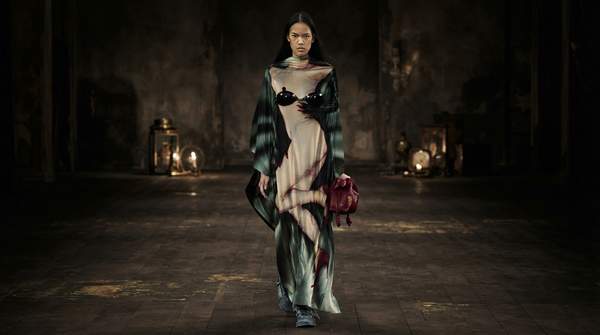
Trompe l'oeil—French for "deceive the eye"—is the art of making a flat surface appear to be something it is not. In fashion, it means building a garment that lies: a sweater that seems to wear a scarf, a shirt that seems to have stepped out of a video game, a boot that seems to be two shoes at once. The technique entered haute couture with Elsa Schiaparelli in 1927, and it has returned in force through three distinct technical routes—knitting, printing, and hand-painting—each of which produces a different kind of illusion.
Historical Roots: Elsa Schiaparelli's Pioneering Illusions
FashionUnited's exploration of illusion in fashion traces the technique's origin to Schiaparelli's 1927 "Bow Knot" sweater, whose knitted design created the illusion of a scarf draped and tied around the neck. The garment is widely credited as the moment trompe l'oeil entered the couture vocabulary: instead of decorating a sweater, the knit pretended to be an accessory the wearer had put on separately.
What matters here is the mechanism. The illusion lived entirely in the knit itself—a pattern worked into the fabric that read, at a glance, as a separate three-dimensional object lying on top of it. The reporting on the sweater describes the visual outcome rather than the specific knitting construction, so the precise stitch architecture remains a matter of craft rather than documented specification. But the principle is clear: the sweater fooled the eye by rendering depth in a flat, flexible medium, and it did so a full century before the technique's current revival.
Modern Techniques for Deceiving the Eye
A hundred years later, the same artistic goal is pursued through strikingly different means. At Loewe's 2023 presentation, the item that flooded social media with commentary was a lifelike pixel shirt by Jonathan Anderson, then the house's creative director—as FashionUnited put it, "It was as if the model had stepped straight out of the metaverse." The Screen Time collection featured ten pixelated garments in all, and Anderson reprised the trick at his 2025 Dior debut, adding an illusory extra layer of fabric beneath knitted cardigans and a crisp white blouse.
The Loewe pieces worked through print and construction: clothes outlined in flat black, in hues Vanity Teen described as yellow-tan and baby blue, delivering what that outlet called "a convincing two-dimensional trompe-l'oeil illusion" evoking 8-bit video game aesthetics. Highsnobiety's take was blunter—the pixelized clothing "so convincingly tricks the eye," the site wrote, crowning Loewe as luxury's reigning trompe l'oeil practitioner. Then there is the third route: for autumn/winter 2023, Louis Vuitton created the illusionary ankle boot, a hand-painted calfskin boot masquerading as black pumps worn with a ribbed white sock.