Macassar Ebony earns its place in luxury design on two counts: a striped grain no other wood reliably reproduces, and a density that makes finished pieces exceptionally durable. It earns caution on two more: it is slow, punishing work for the craftsman, and it is expensive, rare, and listed as vulnerable by the IUCN. For a designer weighing it against more conventional materials, the question is not whether the wood is beautiful, but whether the project can absorb its difficulties.
The Allure of Macassar Ebony in Luxury Design
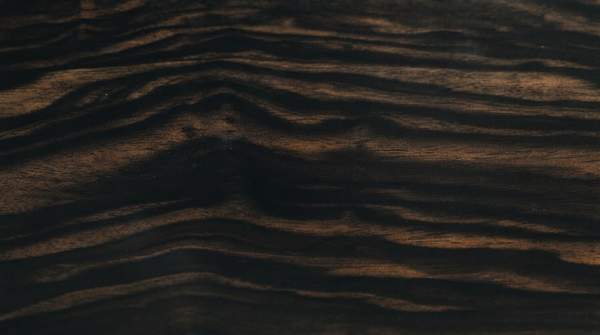
Macassar Ebony, Diospyros celebica, comes from the Indonesian island of Sulawesi and stands among Southeast Asia's best-known exotics. Its defining feature is a classic striped look, prized in luxury furniture since the Art Deco era. Deep brown dominates, while the stripes can carry green, yellow, burgundy, red, orange, and even peach in the finest pieces. Boards with fine, tight, even striping are rarer and more desirable than the usual broad, bold, twisting bands.
Its prestige is not new. Cook Woods, a specialty lumber dealer, notes that the genus name Diospyros originally meant "fruit of the Gods" and that Macassar Ebony "has been used by many kings." Some call it Golden Ebony for its black stripes overlaying golden tones. That historical association with royalty and high-value objects is part of what a client buys when they commission a piece in this wood.
Key Physical Properties and Their Practical Impact
Technically, Macassar Ebony is extreme. Keim Home Center's exotic wood library records a Janka hardness of 3,250 pounds of force, while TiendaShop's materials reference gives an average density exceeding 1,050 kg/m³ and a Janka hardness of roughly 3,200 lbf. At that density, it is one of the few woods that sinks in water under its own weight.
Those numbers translate directly into performance. The wood is naturally resistant to moisture and decay, and LTJarbor's material guide adds that its moisture resistance makes it unattractive to termites and insects, and that furniture made from it resists chipping, warping, and cracking. Cherokee Wood Products rates it excellent for turned objects and veneers with "the potential for a first class finish," and Keim notes it takes a smooth finish and polishes to a high luster. In short: hard to shape, superb to finish.